A snow lens can encounter far more than sunlight and falling snow. Gloves, helmet edges, storage cases, and airborne particles may all come into contact with the optical surface, making abrasion resistance an important consideration in winter eyewear design. For a custom Ski goggles manufacturer, selecting a suitable lens material is only one part of the process; surface protection, optical requirements, frame construction, and intended use must also be considered together. At YIJIA Optical, we approach lens development from this broader perspective, paying attention to how material and surface technologies influence the finished sports eyewear.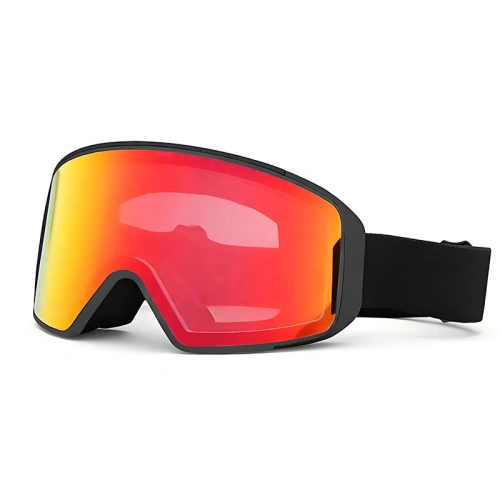
Polycarbonate is valued in sports eyewear because it combines relatively low weight with useful impact resistance. However, the mechanical characteristics of the base material do not mean its exposed optical surface is automatically resistant to every form of abrasion. Repeated contact with rough fabrics or particles can gradually affect surface quality, which may become noticeable as haze or fine marks.
A hard coating adds a protective surface layer that can improve resistance to everyday abrasion. Its role should not be confused with impact protection: the substrate and the coating perform different functions. Polycarbonate contributes substantially to the lens structure, while the surface treatment focuses more specifically on interactions occurring at the exterior.
For Ski goggles with interchangeable lenses, surface durability becomes particularly relevant because users may handle the optical components during lens changes. Frequent lens handling and improper cleaning can increase the risk of surface damage.
The distinction between substrate performance and coating performance helps product developers evaluate lens specifications more accurately.
A hard coating is generally applied as a thin protective layer over the lens surface. Its composition and application process influence characteristics such as adhesion, hardness, optical transmission, and resistance to repeated handling. The coating must remain compatible with the underlying polycarbonate rather than being evaluated as an independent material.
Manufacturing conditions also matter. Surface preparation, coating uniformity, curing parameters, and cleanliness can all affect the final result. Even a technically suitable coating may show inconsistent performance if application conditions vary across the lens surface.
From the perspective of a custom Ski goggles manufacturer, these variables become part of production control. OEM and ODM projects may involve different lens shapes, colors, optical treatments, and production volumes, so the coating process needs to remain compatible with the selected configuration.
A durable surface is consequently the result of material selection and controlled processing working together.
Many lens scratches do not come from a single major event. Instead, small particles can become trapped between the lens and a cleaning cloth, creating repeated micro-abrasion during wiping. Snow residue, dust, and dried moisture can all contribute to this effect if they are removed aggressively.
A sensible cleaning routine therefore matters alongside the coating itself. Loose particles should be handled carefully, and abrasive materials should be avoided. Storage is equally relevant because placing a goggle lens against rough equipment can introduce scratches even when the eyewear is not being actively used.
For Ski goggles with interchangeable lenses, careful handling becomes even more important because the optical components may be removed, stored, and reinstalled according to weather or riding conditions. A protective surface can improve abrasion resistance, but it cannot eliminate damage caused by consistently harsh handling.
Product instructions should make maintenance practical enough that users can follow them in real winter environments.
Interchangeable lens systems offer practical flexibility because users can select different optical configurations according to lighting or activity. Yet every lens exchange introduces another handling cycle, particularly around the edges and mounting points. The surface treatment therefore needs to remain appropriate for the expected handling routine.
Magnetic attachment systems can make lens replacement convenient, but convenience should still be paired with careful storage and cleaning. A lens that is repeatedly placed face-down on a hard surface may accumulate marks regardless of how durable its coating is.
Our team at YIJIA Optical considers these user interactions during sports-eyewear development. For products using interchangeable configurations, we look beyond the visual appeal of lens replacement and consider how the optical components will be handled throughout their practical service cycle.
Durability becomes more meaningful when it reflects actual user behavior rather than laboratory conditions alone.
Testing a hard coating should involve more than a single scratch assessment. Manufacturers can evaluate resistance to repeated wiping, contact with common materials, temperature changes, and exposure to environmental conditions relevant to winter sports. Optical inspection before and after testing can help identify changes in surface appearance.
The relationship between coating and lens geometry also deserves attention. Cylindrical, spherical, or other curved surfaces may present different processing challenges compared with flat optical components. Uniform application is particularly important because uneven surface characteristics can affect both appearance and functional performance.
A custom Ski goggles manufacturer can use this type of evaluation to compare coating options against the project's intended use, lens design, and manufacturing process rather than relying solely on a generic material description.
Practical testing connects a coating specification with the conditions the finished product will actually encounter.
A hard coating does not replace the mechanical properties of polycarbonate, nor does it address every challenge faced by a snow goggle. Its specific contribution is to create a more abrasion-resistant outer surface, helping the optical component withstand routine contact and maintenance. The final result depends on coating formulation, application consistency, lens geometry, cleaning behavior, and the wider construction of the eyewear.
At YIJIA Optical, we consider these elements together when developing sports eyewear, including platforms such as the YH857 with a TPU frame, PC lens, UV400 protection, double-layer anti-fog construction, polarization, and three-layer high-density breathable sponge. For brands developing Ski goggles with interchangeable lenses, surface durability is most useful when it is integrated into a broader lens strategy that accounts for optical performance, handling, maintenance.

