Peripheral vision becomes especially valuable on a mountain, where terrain, other skiers, poles, and changing slope angles can enter the visual field from different directions. The frame surrounding a lens therefore deserves attention alongside the optical surface itself. For brands developing UV protection Ski goggles, understanding how rimless, frameless, and full-frame constructions influence visual coverage can make product decisions more precise. At YIJIA Optical, we approach frame geometry as part of the optical system, while recognizing that field of view also depends on lens curvature, facial fit, and overall goggle dimensions.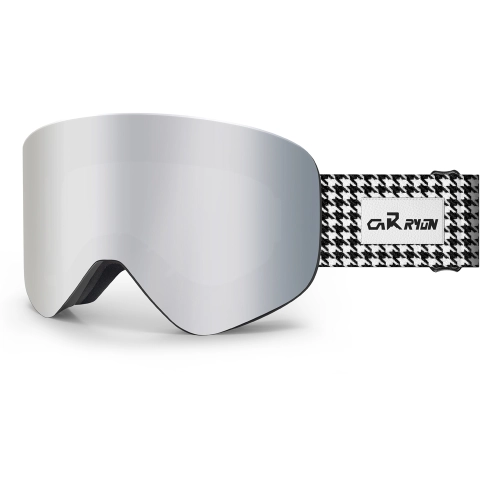
A full-frame goggle surrounds the lens with a more visibly defined structural border. This construction provides a defined structure for mounting and protecting the optical component, while the frame dimensions determine how much of the lens area remains visible from different viewing angles.
Frameless designs reduce the visual prominence of the surrounding structure, often creating a more open appearance around the lens. Rimless constructions can take this concept further, depending on how the lens is supported. Yet a visually minimal frame does not automatically create a wider field of view; lens shape, curvature, bridge geometry, and the relationship between the goggle and the wearer's face remain equally significant.
Consequently, frame style should be assessed as one variable within a larger optical geometry rather than as a simple ranking of visual openness.
Cylindrical lenses curve primarily across the horizontal plane and are common in snow goggles. Their geometry can provide broad lateral coverage while maintaining a relatively straightforward construction. Spherical and toric designs use more complex curvature, which can alter peripheral coverage and optical characteristics in different ways.
The position of the lens relative to the eyes matters as well. A goggle that sits too far forward may create a different perceived visual boundary from one that follows the facial contour more closely. Helmet interaction, nose-bridge clearance, and strap tension can all shift the final position.
For frameless Ski goggles, the large exposed lens can create an open visual impression, but the actual field of view should still be assessed through the complete wearing geometry.
Reducing visible frame material can change the appearance of a goggle, but the structural requirements remain. The lens needs to stay securely positioned during movement, and the surrounding components must tolerate normal impacts and handling. Flexible polymers can provide a useful balance between structural support and comfort in sports applications.
The YH879C provides a practical example, combining a flexible TPU frame with a cylindrical double-lens configuration and features such as anti-fog and UV400 protection. Its OTG-compatible design also addresses the needs of users who wear prescription glasses.
For UV protection Ski goggles, optical coverage cannot be considered independently from lens protection. A broad field of view has greater practical value when the lens also provides the intended environmental protection and remains stable during active use.
Reducing visible frame material should therefore be understood as an engineering choice rather than purely a visual trend.
Different users may prioritize different characteristics. A full-frame structure can appeal to products where durability, component protection, and a defined mechanical architecture are important. A more open construction may suit designs emphasizing a large visual surface and contemporary aesthetics.
Manufacturing considerations also influence the decision. The way a lens attaches to the frame, the available materials, the required tooling, and the intended customization all affect which architecture makes sense. A frame that appears simple from the outside may require careful engineering around its mounting points.
Our team at YIJIA Optical considers these factors during OEM and ODM development because frame architecture needs to remain compatible with lens requirements, intended use, and production feasibility.
The most appropriate construction is ultimately determined by the application's priorities rather than by appearance alone.
Prescription glasses introduce another variable into visual coverage. OTG goggles need enough interior space to accommodate the wearer's frames, yet excessive internal volume may alter the goggle's position on the face. That change can affect how the lens sits relative to the eyes and consequently influence perceived peripheral coverage.
The same principle applies to helmet and face-mask compatibility. A goggle may provide a generous optical area in isolation but behave differently once worn with other equipment. Fit testing should therefore reproduce the complete setup whenever possible.
For brands considering frameless Ski goggles, evaluating field of view with actual helmets, prescription eyewear, and facial dimensions can provide more useful information than judging the lens opening from photographs.
Visual coverage is ultimately experienced by a person, not measured by frame appearance alone.
Ultraviolet exposure remains an important consideration in snow environments because surrounding surfaces can reflect sunlight toward the eyes. Lens protection should therefore be specified according to the intended product requirements rather than inferred from frame construction.
A minimal frame does not inherently provide greater or lesser UV protection. That function comes primarily from the lens and its optical material or treatment. The frame's role is to position and support the lens while contributing to fit and physical protection.
At YIJIA Optical, we treat these functions separately during product development. The YH879C, for instance, combines a flexible TPU frame with a cylindrical double-lens configuration and stated UV400 protection, while its magnetic lens system provides another practical design feature.
Understanding the distinction between frame architecture and lens protection helps buyers compare products on meaningful technical grounds.
Rimless, frameless, and full-frame goggles each represent different approaches to balancing optical coverage, structural support, fit, and appearance. A larger exposed lens can contribute to an open visual experience, yet the actual field of view depends on curvature, eye position, frame geometry, and the complete equipment setup. The meaningful comparison therefore comes from examining the entire optical system rather than assuming that less visible framing automatically means better peripheral vision.
At YIJIA Optical, we evaluate these relationships through sports-eyewear development, with frame materials, lens technology, OTG compatibility, and application requirements considered together. For brands exploring UV protection Ski goggles, the choice of frame architecture becomes more meaningful once optical coverage and lens protection are assessed as separate but interconnected engineering considerations.

